2025 AMC 12A Problems/Problem 24: Difference between revisions
| Line 9: | Line 9: | ||
Let the center of the large circle be <imath>O</imath> and the centers of any two circles be <imath>A</imath> and <imath>B</imath>. Triangle <imath>OAB</imath> has side lengths <imath>r+1, r+1, 2</imath>, with the angle opposite <imath>2</imath> being <imath>360/12 = 30</imath>. | Let the center of the large circle be <imath>O</imath> and the centers of any two circles be <imath>A</imath> and <imath>B</imath>. Triangle <imath>OAB</imath> has side lengths <imath>r+1, r+1, 2</imath>, with the angle opposite <imath>2</imath> being <imath>360/12 = 30</imath>. | ||
Using Law of Cosines, <imath>2^2=AO^2+BO^2-2AOBO</imath> | Using Law of Cosines, <imath>2^2=AO^2+BO^2-2AOBO\cos30</imath> | ||
== Solution 2 == | == Solution 2 == | ||
Revision as of 15:17, 6 November 2025
Problem
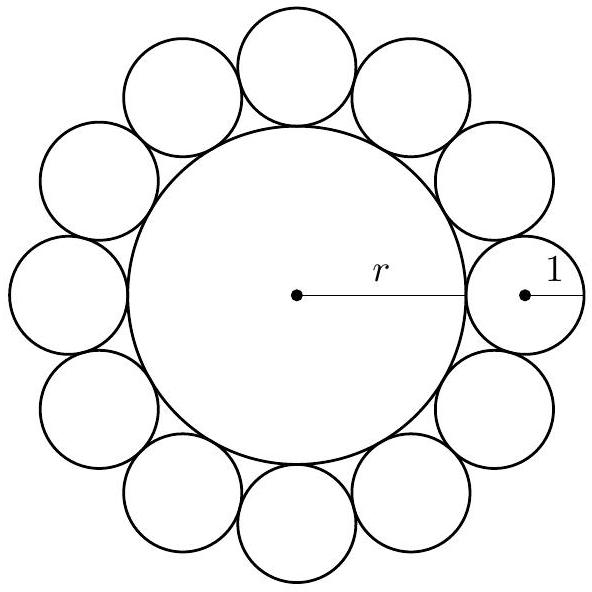
A circle of radius  is surrounded by
  circles of radius
  externally tangent to the central circle and sequentially tangent to each other, as shown. Then can be written as
  where
where  are integers. What is
[center][img width=60]https://wiki.randommath.com/amc/2025_11_05_e415ed6e80d65fa550edg-7.jpg[/img][/center]

Solution 1
Let the center of the large circle be  and the centers of any two circles be
  and
and  . Triangle
  has side lengths
  , with the angle opposite
  being
being  .
.
Using Law of Cosines, 
Solution 2
Let the center of the large circle be and the centers of the circles be  . Triangle
  has side lengths , with the angle opposite being .
Drawing the angle bisector of the  degree angle, we split into two congruent right triangles, each with hypotenuse
  and side opposite the
  degree angle
  .
.
From here, note that  , which be derived using the trigonometric identity
  , with
  and
and  .
.
In our right triangle,  . Let
. Let  . Solving for
  , we get
  . Rationalizing, we get that
  .
.
Remember  , so
, so  . Therefore, our answer is
~lprado